

Learning businesses rarely falter because they offer too little. More often, they struggle because their portfolios have grown in ways no one intentionally designed. Some offerings clearly advance the organization’s purpose. Others clearly generate revenue. Some do both. And some, if examined honestly, do neither.
For associations, the tension is often framed as mission versus money. For commercial learning providers, it may appear as impact versus profitability or brand promise versus short-term revenue. Whatever the language, the underlying challenge is the same: how to balance advancing your purpose and sustaining your organization financially.
Too often, this conversation happens informally—or not at all. Leaders rely on instinct, tradition, or isolated financial snapshots. Boards see high-level revenue numbers but lack visibility into which offerings truly pull their weight. Staff know some programs feel important and others feel profitable, but rarely is there a shared evaluation along both dimensions.
The Mission-Margin Matrix™ can help. It provides a way to evaluate your learning offerings along two essential dimensions: how strongly they contribute to your purpose and how sustainably they support your financial health. By making tradeoffs visible, the matrix turns fuzzy logic into a structured, strategic conversation and helps leaders focus limited resources where they matter most.
Introducing the Mission-Margin Matrix
The Mission-Margin Matrix is a strategic portfolio tool that helps learning businesses evaluate offerings based on two essential dimensions: contribution to mission and ability to generate sustainable net revenue.
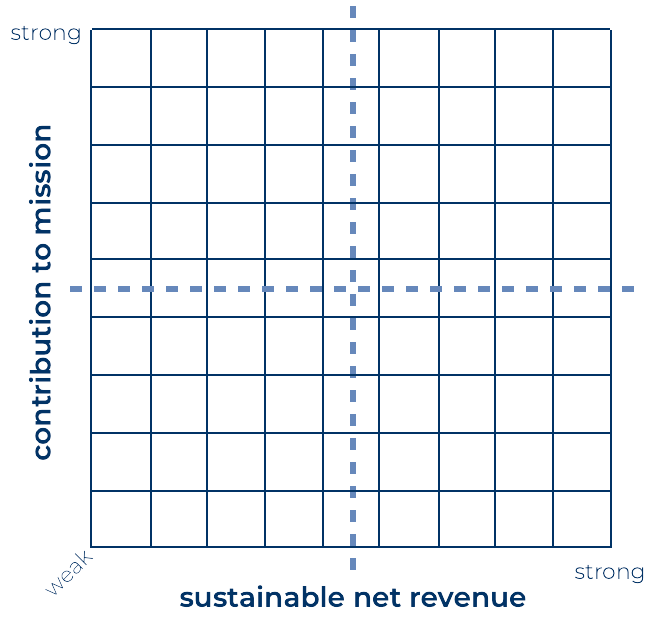
While associations tend to use the language of mission, every learning business has a purpose—an articulated or implicit reason it exists. That purpose may be advancing a profession, improving workforce capability, preparing learners for certification or licensure, or supporting career progression in a defined field. The mission dimension of the matrix asks how strongly an offering contributes to that purpose.
The second dimension, margin, examines financial sustainability—not gross revenue but sustainable net revenue. After accounting for direct and indirect costs, staff time, marketing investment, and ongoing support, does this offering meaningfully contribute to the organization’s financial health?
These two dimensions create a four-quadrant view of a learning portfolio. Each offering can be placed somewhere on this matrix. In an ideal portfolio, every product would sit in the upper right quadrant. In reality, few portfolios are so tightly clustered.
The goal is not to idealize your portfolio but to understand it as it operates now. The Mission-Margin Matrix is a diagnostic tool that helps you visualize how your portfolio truly performs.
Before examining the four quadrants, let’s look more closely at the two dimensions themselves.
Understanding the Two Dimensions
Contribution to Mission
For associations, mission is usually explicit: advancing a profession, improving workforce capability, strengthening professional standards, or serving a defined community. For commercial learning businesses, the language may differ, but the underlying question remains the same: How strongly does this offering advance the organization’s core purpose?
Contribution to mission is not measured solely by enrollments or popularity. An offering may attract large numbers of learners yet contribute only marginally to long-term strategic goals. Conversely, a niche program may serve a smaller audience while playing a critical role in advancing the field or reinforcing professional standards.
Assessing mission contribution requires clarity about what the organization exists to accomplish. Without that clarity, strong financial performance can overshadow weak mission alignment, and important mission work can be undervalued if it does not generate sufficient revenue.
Sustainable Net Revenue
The second dimension focuses on financial contribution, but the relevant question is not simply whether an offering generates revenue. It is whether it generates sustainable net revenue.
That means accounting for direct and indirect costs, staff time, marketing investment, technology infrastructure, and ongoing support. An offering that appears profitable at first glance may look very different once full costs are considered. Likewise, an offering that currently operates at a loss may have a credible path to sustainability with adjustments to pricing, positioning, or cost structure.
Financial contribution is not about maximizing short-term profit. It is about ensuring that the portfolio supports the organization’s long-term health.
Judgment Is Required
Neither dimension is binary. Mission contribution and financial sustainability both exist on a spectrum. Even with financial data and clearly articulated strategic priorities, leaders must make informed judgments about how each offering truly performs on both dimensions.
Those judgments become far more valuable when shared.
The Four Quadrants
The Sweet Spot: High Mission, High Margin
The upper right quadrant represents offerings that strongly advance the organization’s purpose and generate sustainable net revenue. These are the offerings leaders hope to cultivate: programs that reinforce strategic priorities while contributing materially to financial health.
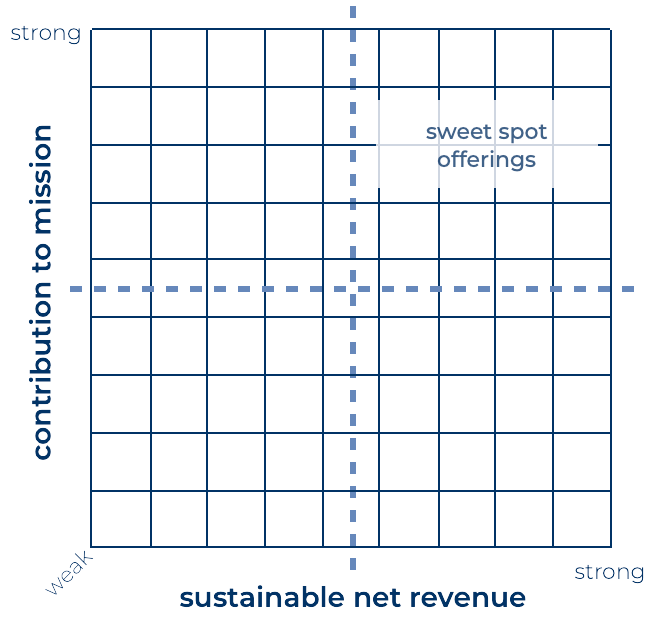
In many portfolios, flagship certifications, high-demand conferences, or well-established courses land here. They attract sufficient enrollment to cover full costs, generate surplus, and reinforce the organization’s credibility and mission.
Offerings in this quadrant deserve protection and continued investment. They can also serve as models. What makes them successful? Is it pricing strategy, positioning, market demand, delivery format, or alignment with core competencies? Understanding why these offerings thrive can inform the development or redesign of other products.
That said, even sweet-spot offerings should not be taken for granted. Markets evolve. Costs shift. Learner expectations change. Sustained success requires ongoing attention.
Offerings to Retire or Redesign: Low Mission, Low Margin
The lower left quadrant contains offerings that neither strongly advance the organization’s purpose nor generate sustainable net revenue.
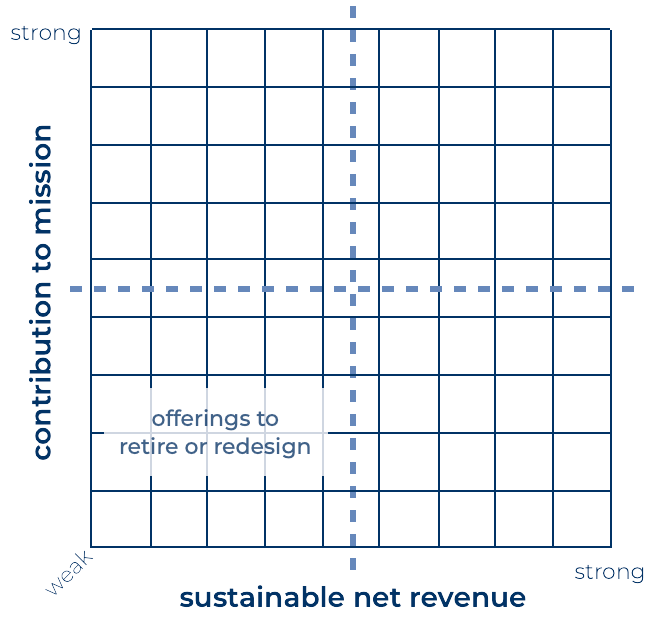
In theory, decisions about this quadrant should be straightforward. In practice, they often are not.
Legacy programs, long-standing partnerships, or offerings launched under different strategic priorities can persist long after their relevance has faded. Enrollment may be modest. Financial contribution may be minimal or negative. Mission alignment may be tenuous.
The risk lies in allowing offerings in this quadrant to remain unexamined. When a product does not meaningfully contribute to mission and does not support financial health, the two rational options are redesign or retire. Redesign may involve clarifying audience, revising content, adjusting pricing, or rethinking delivery. If meaningful improvement is unlikely, retirement may be the more responsible choice.
Removing offerings from this quadrant is not about shrinking the portfolio. It is about creating capacity—freeing time, attention, and resources to invest where impact and sustainability are stronger.
Mission Subsidy: High Mission, Low Margin
The upper left quadrant includes offerings that strongly advance the organization’s purpose but do not generate sustainable net revenue. These programs may break even or operate at a loss.

Offerings in this quadrant can feel essential. They may serve strategically important audiences, address emerging issues, or reinforce the organization’s identity and credibility. Their mission value is often clear even if their financial contribution is limited.
The presence of mission-subsidy offerings is not inherently an issue. In many portfolios, stronger-performing offerings support ones that are mission-critical but less financially self-sustaining. The critical question is whether that subsidy is explicit and strategic.
Leaders should be able to articulate why an offering remains in this quadrant and what level of financial support is appropriate. In some cases, the subsidy may be time-bound, as newer offerings build awareness and scale. In others, the organization may decide that long-term subsidy is justified.
Even so, it is worth examining whether improvement is possible. Adjustments to pricing, delivery, partnerships, cost structure, or positioning may move an offering closer to sustainability even if it does not fully transition into the sweet spot.
Existential Subsidy: Low Mission, High Margin
The lower right quadrant includes offerings that generate strong net revenue but do not meaningfully advance the organization’s core purpose.

These products often emerge in response to market demand or revenue opportunity. They may serve adjacent audiences, cover topics outside the organization’s primary focus, or prioritize financial return over mission alignment.
These offerings are not necessarily problematic. In many portfolios, revenue-generating programs provide critical financial support that enables mission-critical work elsewhere. When managed intentionally, such offerings can strengthen overall sustainability.
The risk arises when financial success begins to distort strategic focus. If disproportionate attention, staffing, or brand identity shifts toward offerings that are only loosely aligned with mission, the organization may drift from its purpose.
Examine this quadrant carefully. Is the financial contribution worth the strategic tradeoff? Could the offering be better aligned with mission? Would divesting free up capacity for higher-impact work? In some cases, selling or licensing such programs may generate capital while allowing leadership and staff to refocus attention.
As with the mission subsidy quadrant, clarity and intentionality about what stays is essential.
How to Use the Mission-Margin Matrix
The Mission-Margin Matrix is most powerful when used as a social learning object and shared portfolio exercise rather than a tool used by a single individual.
Ideally, this exercise includes not only the education team but also representatives from finance, marketing, product development, and executive leadership. Each group brings a different perspective: financial data, market insight, mission priorities, operational realities. When those perspectives are surfaced together, placement becomes more accurate, and the conversation becomes more strategic. Involving board members in a later review can further strengthen alignment and transparency.
Start by listing your major offerings. (If you offer many products and feel you won’t lose important nuance, you may plot product lines rather than individual products.) Plot each offering on the matrix based on current performance, not aspiration. Again, the goal is diagnostic clarity.

If there is disagreement about where an offering fits, discuss enough to understand why. Perhaps you lack accurate or up-to-date financials. Perhaps there’s not shared clarity around strategic, mission-aligned priorities.
Once the portfolio is mapped, patterns often emerge:
- Clusters in one quadrant
- A concentration of legacy offerings in the lower left
- Heavy reliance on one or two revenue-generating programs
- Mission-critical initiatives that consistently require subsidy
- Few offerings in the sweet spot
These observations provide a foundation for strategic conversation.
- Portfolio review
Are we allocating time and attention proportionally to impact and sustainability? - Pricing strategy
Could adjustments move mission-subsidy offerings closer to sustainability? - Budget prioritization
Where should we invest? - Portfolio clarity
Can we clearly articulate how each offering contributes to mission, margin, or both? - Product lifecycle decisions
Which offerings should be redesigned, scaled, or retired?
Importantly, the matrix does not prescribe uniformity. A healthy portfolio may include offerings in multiple quadrants. What matters is that their placement is intentional and understood.
When used in this way, the matrix becomes more than a diagram. It becomes a shared language for discussing tradeoffs, investments, and strategic focus.
Connecting Mission and Margin to Reach, Revenue, and Impact
The Mission-Margin Matrix clarifies how each offering contributes to purpose and sustainability and helps leaders assess the structural health of their portfolio—where offerings advance mission, generate margin, and require tradeoffs.
Seen through this broader lens, the matrix complements a focus on reach, revenue, and impact. Revenue and margin are closely related. Mission and impact overlap. Reach amplifies mission and margin.
An offering that strongly advances mission but reaches only a handful of learners delivers limited realized impact. An offering that generates healthy margin but serves a very small audience constrains its contribution to overall revenue. Growth in reach expands the influence of both mission and margin.
Together, these perspectives support more disciplined strategy. Leaders can pursue growth without sacrificing purpose. They can protect mission without ignoring sustainability. And they can make tradeoffs explicitly rather than reflexively.
Balancing mission and margin isn’t a one-time exercise. Portfolios evolve. Markets shift. Organizational priorities change. The value of the matrix lies not in a perfectly plotted diagram, but in the clarity and conversation it enables.
Used consistently, it becomes more than a tool. It becomes part of how you lead learning.
About the Author
Celisa Steele is a co-founder of Leading Learning and a co-founder and managing director of Tagoras, the company behind Leading Learning. Celisa has spent the last 25+ years working in the market for adult lifelong learning. She co-hosts the Leading Learning Podcast and co-authored the executive briefing “Where Mission and Margin Meet: How Association CEOs Think About Learning and Education,” where the Mission-Margin Matrix was first introduced.
 Leading Links Sample Issue
Leave a Reply