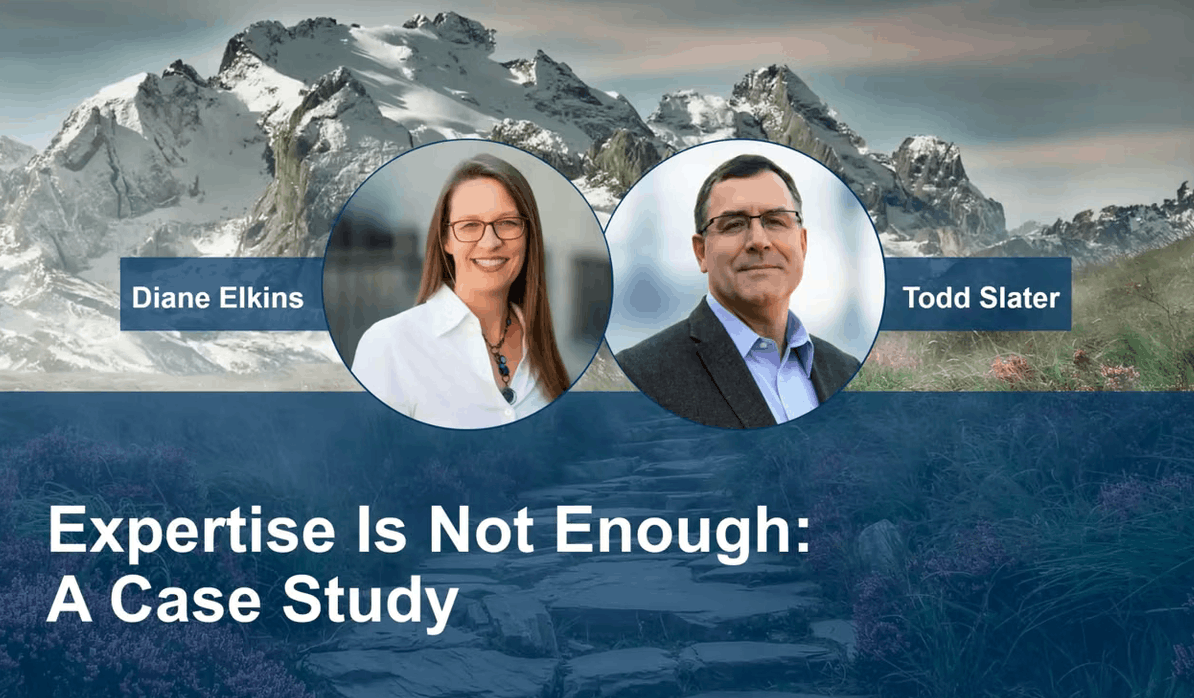
ASAE has named NIGP: The Institute for Public Procurement a recipient of a 2026 Power of Associations Gold Award. The recognized program is titled “The Public Procurement Profession Redesigned: Competencies, Credentials, and Real-World Practice” and, as it happens, Todd Slater — then Chief Content Officer at NIGP, now Chief Learning Officer — and Diane Elkins, co-founder of Artisan Learning, spent a session at the 2025 Learning Business Summit walking our attendees through the redesign that title references.
We thought it would be worth providing a replay of the session here for exactly the reason we invited Todd and Diane to present at the Summit: the redesign was an example of great work that it would be valuable for learning business leaders to know about. So, below you’ll find the recording and, after that, some commentary on the session and the award.
What an Award Citation Can’t Tell You
Todd’s quote in the NIGP announcement says the award recognizes “the intentional design, innovation, and impact behind every learning experience we create.” That’s true. It is also, unavoidably, abstract. Most associations would say something similar in a press release.
What the Summit session did — and what an award announcement can’t really do — was show the mechanism. Not the results. The method that produced them.
Here is the “before” picture Todd describes: 95 percent-plus of NIGP’s education delivered in a classroom, three and four day courses running eight in the morning to six at night, built off a textbook, pitched simultaneously at people who knew nothing and people who knew everything. Pricing out of line. Roughly five foundational courses to choose from. And 70 instructors teaching a single course 70 different ways, which meant, as Todd put it, there was no way to assess against it and no way to promise a consistent outcome.
The “after” picture: seven focus areas, about 33 competencies, a credential structure that scaffolds from individual digital badges through certificates and designations up to a certification, all of it portable because the metadata travels with the person when they change agencies. Over 30 foundational courses and 10 advanced. More than 11,000 badges awarded. Three times the registration numbers.
That’s the part that makes the award citation. Now the part that doesn’t.
The Discipline That Got Them There
The design work ran on Cathy Moore’s action mapping (catch our interview with Cathy here) and Diane was unusually specific about how she uses it with subject matter experts.
You start with a business goal, then identify the on-the-job behaviors that reach it. Every one of them has to open with an action verb. And here is the rule that does the actual work: the words know, learn, and be aware of never get typed on the map. Not once. When a subject matter expert says “they really need to know the RFI process,” the response is “great — what do they need to do?” The word “know” is a fine place to start a conversation and a terrible place to end one.
Diane took attendees through a quick sort to make the point. List the twelve principles of agile software: knowledge. Create an effective agenda: action. Define workplace violence: knowledge — and not a bad thing to be able to do, but if the real behavior is report workplace violence, the definition is not sufficient. Diane’s challenge to the audience was to go back and look at their own learning objectives, and if those objectives are built on list, describe, define, and explain, recognize that all of those words are just stand-ins for “knowledge.”
Then two steps most design processes skip.
What makes it hard. Before designing anything, they asked why people aren’t already doing the behavior. Lack of knowledge? Lack of motivation? Lack of skill? Or obstacles — time, support, disincentives. It matters, because you teach terminology one way and “you are going to have to deliver bad news to an internal customer who already has a vendor they like” a completely different way. In NIGP’s case a surprising number of the obstacles turned out to be interpersonal rather than informational.
Practice before content. For each behavior they asked whether the learner could do it well without practice, and if not, they designed the practice activity before deciding what to teach. Diane’s stem: give them ______ and they ______, with an action verb in the second blank. Give them a sample contract and they determine which clauses are inconsistent with the proposal. Give them four credit cards and they decide which are tampered with. If you can’t fill in the verb, that’s a signal about the objective, not about your imagination.
Only then did they identify the knowledge required. As Diane framed it, nothing goes on the map unless it feeds a practice that feeds a behavior that meets the goal. That’s the cut-the-fluff mechanism, and it’s a structural one rather than a matter of editorial willpower.
A key line of hers well worth taking to heart: your objectives are your marketing. Nobody takes time out of a working week to identify tools and associate them with categories.
The Part That Doesn’t Make the Press Release
Todd was candid that this was a change initiative at least as much as a design initiative, and that the design was the easier half.
Leadership and the board got business plans, communication plans, and reported milestones and challenges across a four-year build — specifically so that nobody would be surprised halfway through and the funding would still be there at the end. Staff needed training on methods they didn’t have. And the instructors, some of whom had taught the old material for decades, had to become facilitators.
Diane named the real resistance accurately: it isn’t stubbornness, it’s loss of control. The sage on the stage is fully in charge. Run a real activity and you’ve handed a good deal of that control to the room, where people will get things wrong in front of you and you may not know what to do about it. Being a strong presenter is genuinely not the same skill as managing an activity. Todd’s assessment, more than a year on, was that they were “almost there.”
The SME facilitation sessions, incidentally, happened at night and on weekends, mid-pandemic, in between conversations about how to source bleach for firefighters. There was plenty of commitment to go around.
Why The Case Study Approach
We built the Summit around paired case studies for a straightforward reason: association learning leaders are drowning in best practices and starved for specifics. A best practice tells you competency-based design works. A case study run by the person who did it, alongside the designer who helped, tells you that “should they practice this?” and “can you think of a practice?” are different questions and that subject matter experts will answer the first by accident when you meant to ask the second.
Todd, for his part, hasn’t been a one-time guest. He’s presented at Leading Learning @ RevUP, he’s a long-time member of the Learning Business Mastermind, and he was back on the Summit stage in 2026. The relationship between this community and work of this caliber runs in both directions.
Now, obviously, this is just one example, and the work predates the Summit session. We don’t have crystal ball for which organizations ASAE will honor. But we do select for organizations that have done the hard, unglamorous, multi-year work that is usually necessary for building a successful learning business and that are willing to share in detail how they did it. Sometimes the rest of the sector catches up and hands them a Gold Award. More often it doesn’t, and the work is just as worth your attention either way.
Congratulations to Todd and the NIGP team and to Diane and the Artisan team. ASAE will recognize the Power of Associations recipients at its Summit Awards Dinner on September 22 at the National Building Museum in Washington, DC.
And, of course, you can find out more about the Learning Business Summit here.
 Associations at the Inflection Point with Artesha Moore
Leave a Reply